French tourist tax: the practical guide for hotels, campsites and holiday rentals


Photo: Aaron Lefler / Unsplash
A guest disputes the "tourist tax" line on their bill. A declaration forgotten in the middle of the season. A late payment, and interest building up without anyone noticing. The French tourist tax (taxe de séjour) isn't an administrative detail. It's a tax obligation, with rules, deadlines and consequences. Applied correctly, it costs your property nothing. Applied badly, it costs a lot - in time, money and peace of mind.
This guide brings together the essentials of the French tourist tax for hoteliers, campsite managers and holiday rental owners: who pays, who collects, which scheme applies, which rates, which exemptions, what goes on the bill. A golden rule before you start: things aren't uniform across France, and it's your local authority that sets the details.
In brief
An optional tax, decided locally. It isn't introduced by the State but by the municipality or the EPCI (inter-municipal body), by a decision taken before 1 July to apply from the following 1 January (service-public.fr).
The guest pays, you collect. People staying who aren't resident in the municipality are liable. You're the intermediary, not the taxpayer.
Two schemes, two logics. Actual (per person and per night) or flat rate (based on capacity, with an allowance).
Regulated rates. A national scale by category, updated every year, which municipalities apply within certain limits.
Four exemptions to know. Minors, seasonal workers, emergency accommodation, occupants of low-rent housing.
Deadlines not to miss. Late-payment interest of 0.20% per month applies if you pay late.
What is the tourist tax, and who introduces it?
The tourist tax is a local tax, and it's optional. It doesn't exist everywhere in France. It's introduced by a decision of the municipality or the EPCI - an inter-municipal cooperation body - taken before 1 July, to apply from 1 January of the following year.
In practice, two consequences for your property:
No decision, no tax. A municipality that hasn't voted anything collects nothing, and you charge nothing.
Decision adopted, obligation to collect. As soon as it exists, you must collect it on behalf of the local authority, then pay it over.
What is this money for? To fund tourism promotion and the facilities that welcome visitors: tourist office, events, upkeep of sites. You don't pay this tax, but you're the first link in the chain. The full legal framework is in the French General Code of Local Authorities, articles L. 2333-26 and following.
Who pays the tourist tax, and who collects it?
Two roles, never to be confused. This is the most common confusion - and the source of most mistakes.
The person liable is the guest. The tax is due from the people staying who aren't resident in the municipality. The tourist pays, not the hotelier.
The collector is you. Hotel, campsite, furnished tourist rental, B&B, holiday residence: you collect the tax on behalf of the local authority, then pay it over. Booking platforms can also act as collection intermediaries.
Your mission therefore comes down to three things: collect correctly, declare correctly, pay over on time. No more, no less. You're not the taxpayer, but you're personally responsible for the quality of the collection.
Actual or flat rate: the two schemes explained simply
It all depends on the scheme chosen for your accommodation. And the two don't follow the same logic.
The actual scheme (au réel). The tax is due from the guest not resident in the municipality, and collected stay by stay, based on the people and nights actually used. The more guests you host, the more you collect. It appears separately on the bill, with a mandatory statement.
The flat-rate scheme (au forfait). The tax is due from the landlord or hotelier, not from the end guest. It's calculated on the accommodation capacity, after an allowance of 10% to 80% depending on the type of accommodation. It doesn't depend on occupancy: it's due even if the property is empty.
Criterion | Actual | Flat rate |
|---|---|---|
Who is liable | The non-resident guest | The landlord or hotelier |
Calculation base | People × actual nights | Accommodation capacity, minus an allowance of 10% to 80% |
Link with occupancy | Direct | None |
Statement on the bill | Mandatory and separate | Not mandatory |
Declaration | When paying it over | No later than one month before each collection period |
Reassuringly, a mixed scheme (for example actual for some categories and flat rate for others) is allowed. The Constitutional Council approved the flat-rate and mixed schemes in its decision no. 2023-1078 QPC of 8 February 2024. If your municipality combines the two, it's legal - but you need to follow the right scheme, accommodation by accommodation.
Rates and the scale
The law sets a national scale by accommodation category. Municipalities then vote their rate within these limits, updated every year in line with inflation (collectivités-locales.gouv.fr).
The practical result: two neighbouring municipalities can apply two different rates for the same 3-star hotel, and a campsite may not be taxed like a hotel. You can't rely on memory or on the previous year.
Two families of rates:
Classified accommodation (hotels, residences, furnished tourist rentals, holiday villages, campsites, B&Bs, hostels): the rate follows the category and number of stars, within the limits of the scale. The official details are published on service-public.fr.
Unclassified accommodation: the tax is proportional, from 1% to 5% of the night's price excluding tax.
The rates voted are published: local authorities must enter their decisions in the DGFiP's DELTA application, open from 1 January to 15 September. The data can be viewed publicly through the DELTA tourist tax rates dataset. The best reflex remains the same: ask your town hall for the decision in force.
Exemptions: who doesn't pay the tourist tax?
Four categories are exempt, according to the official service-public.fr fact sheet:
Minors under 18.
Seasonal workers, housed for their work.
People in emergency or temporary accommodation (emergency housing, rehousing).
Occupants of low-rent housing.
Add to this something obvious that is sometimes forgotten: people resident in the municipality are not liable. They're your neighbours, not your tourist guests.
Why does it matter strategically? Because applying exemptions badly has a double negative effect: you collect too much from the guest, and you pay too much to the municipality. The first earns you a complaint at reception; the second makes you bear a cost that wasn't yours. Training the front-desk team on these four cases avoids both.
Declaration and payment: obligations, deadlines and late-payment interest
The timing and content of the declaration depend on the scheme.
Actual scheme. You declare when paying over the tax collected. The information required is precise: number of people accommodated, number of nights, amount of tax collected, date of collection, start date of the stay and address of the accommodation (DGFiP practical guide).
Flat-rate scheme. The declaration must be submitted no later than one month before the start of each collection period.
And if you miss the date?
Late-payment interest of 0.20% per month applies to the sums due.
The mayor or the president of the EPCI can issue an automatic tax assessment on the defaulting declarant.
Two tools now structure collection on the local authority side: the DELTA platform for entering rates, and the FARITAS trial, a single declaration system for booking platforms, planned over three years. For owners who use several channels, it's worth a look: it simplifies declaration, but doesn't exempt anyone from keeping track of their payments.
The bill: mandatory statements, VAT and the difference between the two schemes
This is where the most practical difference between the two schemes lies.
Actual scheme: the tourist tax statement is mandatory on the bill, and separate from the room price. It is not part of the VAT base. You charge it, you collect it, you pay it over - it never goes through your turnover.
Flat-rate scheme: the statement on the bill isn't mandatory, and the tax is included in the landlord's VAT base. So it doesn't appear as a separate line.
The direct consequence: if you confuse the two, your accounts go wrong. Under the actual scheme, the tax must never inflate your taxable turnover. Under the flat-rate scheme, it is part of your base. The right reflex is to set the scheme up once and for all in your billing tool, rather than patching the line at every arrival.
Departmental and regional surcharges
Surcharges are sometimes added to the base rate. They don't go to your municipality: they fund the departments and certain regional projects.
Additional departmental tax: 10%. The department can vote a surcharge if it carries out tourism promotion.
Surcharge in Île-de-France: 200%, to fund transport in the Paris region.
Regional surcharges linked to major projects: 15% for the Société des Grands Projets, 34% for LNPCA, GPSO and LNMP (collectivités-locales.gouv.fr).
These percentages apply to the rate voted by the municipality. Not passing them on means collecting less than the local authority expects - and discovering the gap at inspection. A seaside hotel and a mountain campsite aren't exposed to the same surcharges: it's exactly the kind of parameter to check locally.
Mistakes to avoid
Here are the most common mistakes, and what they cost.
Believing the tax is due from the property. No: the non-resident guest is liable - except under the flat-rate scheme, where the landlord is liable.
Skipping the exemptions. Minors, seasonal workers, emergency accommodation, low-rent housing: not applying them means over-collecting.
Using an outdated rate. The scale is updated every year and municipalities re-vote their rates. Last year's rate is a wrong rate.
Forgetting departmental and regional surcharges. A silent gap that you pay for at inspection.
Not distinguishing the two schemes on the bill. Mandatory statement under the actual scheme, optional under the flat rate: doing the opposite creates an accounting anomaly.
Including the actual-scheme tax in turnover. Under the actual scheme, it isn't part of the VAT base.
Declaring too late. Late-payment interest of 0.20% per month, and a possible automatic assessment.
Not declaring under the flat rate before the collection period. The deadline is at least one month before the start of each period.
Letting reception improvise. A poorly trained front desk charges the tax at random - and answers an unhappy guest at random too.
How automation simplifies collection
The tourist tax is an excellent candidate for automation. The calculation depends on stable rules: category, municipal rate, number of nights, exemptions, surcharges. Once these parameters are entered, the machine can do the rest.
In practice, a suitable solution can:
apply the right rate according to the category and the municipality, without manual calculation;
automatically exclude exempt people, based on the stay data;
add the actual-scheme tax statement in the right place on the bill, separate from the room price;
distinguish the two schemes and preserve the correct VAT base;
produce the declaration statements and send reminders before deadlines pass;
answer guests' questions about the bill line, directly on the property's website, in the visitor's language.
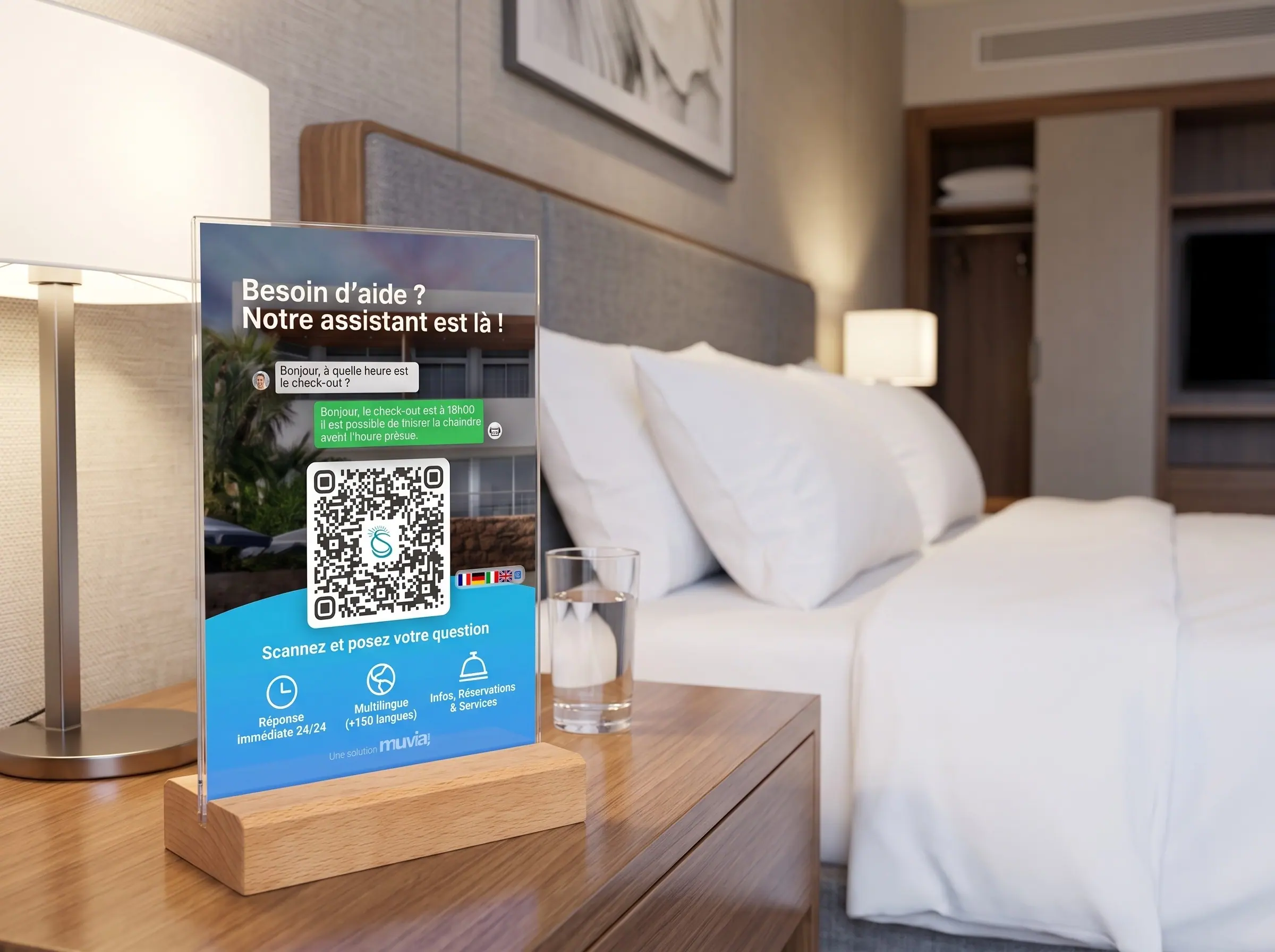
That's the promise of a tool like Muvia, which automates guest relations and operations for hotels, campsites and holiday rentals, directly on the property's website. We mention it because it directly addresses today's problem. But the principle applies to any tool: what's entered correctly once doesn't have to be recalculated a thousand times. Automation doesn't replace checking your local decision; it simply ensures you apply it without mistakes, stay after stay.
Frequently asked questions
Who is liable for the tourist tax?
The tax is due from people staying who aren't resident in the municipality - in other words, your tourist guests. Under the flat-rate scheme, the landlord or hotelier is liable. In every case, you're the collector: you collect it and then pay it over (service-public.fr).
What's the difference between the actual and the flat-rate tourist tax?
Under the actual scheme, the tax depends on the number of people and nights actually used, is due from the guest and must appear on the bill. Under the flat-rate scheme, it's due from the landlord, calculated on accommodation capacity with an allowance of 10% to 80%, and stating it on the bill isn't mandatory.
Do minors pay the tourist tax?
No. People under 18 are exempt, as are seasonal workers, people in emergency accommodation and occupants of low-rent housing.
What happens if a declaration is forgotten or payment is late?
Late-payment interest of 0.20% per month applies to the sums due. The mayor or the president of the EPCI can also issue an automatic tax assessment on the defaulting declarant.
Is the tourist tax subject to VAT?
It depends on the scheme. Under the actual scheme, the tax is shown separately on the bill and isn't part of the VAT base. Under the flat-rate scheme, it's included in the landlord's VAT base.
Useful sources
Service-public.fr (Entreprendre) - Tourist tax on tourist accommodation (fact sheet F743)
Service-public.fr (Entreprendre) - Tourist tax rates (fact sheet F31635)
Collectivités-locales.gouv.fr - The tourist tax
Collectivités-locales.gouv.fr - Practical guide to tourist taxes
Impots.gouv.fr - Tourist tax
Online declaration portal - taxesejour.impots.gouv.fr
Légifrance - General Code of Local Authorities, articles L. 2333-26 and following
Ministry of the Economy - Landlords and hoteliers: the tourist tax
Data.gouv.fr - DELTA tourist tax rates from 2024
Important reminder: tourist tax rules vary from one French municipality to another - rates, collection periods, scheme, surcharges. This article presents the general principles from official sources, but it doesn't replace local information. Always check the decision in force with your town hall or EPCI before charging.
More articles
Discover more articles from Muvia Solutions


Properties
- HotelsTake the load off reception, day and night.
- CampsitesA welcome that holds up in peak season.
- Holiday residencesThe instructions for every apartment.
- HostelsAnswer every traveller in their own language.
- Holiday cottagesYour welcome book, even when you're away.
- Groups & chainsAll your properties in a single account.
Marketing, upselling & revenue
AI assistant & conversation
Digital welcome book
Resources